
Somewhere on your next food tour, a guide will tell you that the pizza margherita was named for a queen in 1889, that Catherine de' Medici taught the French to cook, and that UNESCO has recognised the local cuisine. All three are said with total confidence. One is contested, one was invented by an encyclopaedia in 1754, and the third is almost always a description of something else.
We are not interested in catching guides out. Most of these stories are repeated in good faith, and a few of them are lovely. But this site sells food tours in sixteen cities, and if we are going to put the words where locals actually eat under our logo, the least we can do is check what we repeat. So we went to the registers, the gazettes and the newspaper archives. Here is what survived.
What UNESCO actually listed
This is the single most common error in food tourism, and it is not really a myth so much as a habit of compression. Five of the countries on this site have a food entry on the UNESCO Representative List of the Intangible Cultural Heritage of Humanity. In four of the five cases, the thing listed is not the thing people name.
| Year | What you will hear | What the register says | Ref. |
|---|---|---|---|
| 2010 | Mexican food is UNESCO heritage | Traditional Mexican cuisine, ancestral, ongoing community culture, the Michoacan paradigm. It lists the maize, beans and chilli system, nixtamalisation, the milpa, and the collectives of traditional cooks | 00400 |
| 2013 | Japanese food is UNESCO heritage | Washoku, traditional dietary cultures of the Japanese, notably for the celebration of New Year. Sushi and ramen do not appear in the text | 00869 |
| 2017 | Neapolitan pizza is UNESCO heritage | Art of the Neapolitan Pizzaiuolo. It protects a craft and the way it is passed on inside the workshop, not the product | 00722 |
| 2020 | Couscous is Moroccan heritage | Knowledge, know-how and practices pertaining to the production and consumption of couscous, filed jointly by Algeria, Mauritania, Morocco and Tunisia | 01602 |
| 2023 | Peruvian cuisine is UNESCO heritage | Practices and meanings associated with the preparation and consumption of ceviche. One dish, and strictly speaking the practices around it | 01952 |
The pattern is the same every time. UNESCO lists knowledge and the transmission of knowledge, because that is what intangible heritage means. It does not award prizes to cuisines, and it has never ranked one against another. A guide who says the register recognises the excellence of the local food has read a headline rather than a citation.
The couscous entry is worth a second look, because it is the only one filed by four countries at once. It is also routinely retold as a story about rival neighbours setting aside their differences. That framing is anachronistic: the inscription is from December 2020, and the diplomatic rupture people have in mind happened in August 2021.

The rule that is stricter than the legend
While the queen story wobbles, there is a document about Neapolitan pizza that nobody quotes and that is far more demanding than any anecdote. Commission Regulation (EU) No 97/2010 registered Pizza Napoletana as a Traditional Speciality Guaranteed, and the specification reads like an engineering standard: the oven floor at 485 degrees and the dome at 430, a bake of sixty to ninety seconds, flour of a specific strength, a maximum diameter of 35 centimetres, a centre four millimetres thick, a rim of one to two.
It also bans the rolling pin and any mechanical press. The dough is opened by hand, and that is written into European law. Our Italy pages go into what this means when you are standing in front of an oven in Naples.
Stories that do not survive the archive
These are the ones where somebody went and looked, and the paperwork says otherwise.
America's first pizzeria was not Lombardi's, and not 1905. Peter Regas went through Manhattan city directories, Italian-language newspaper advertisements, wartime draft cards and a photograph from 1908, and found that the shop at 53 Spring Street was opened by Filippo Milone in the summer of 1898. Giovanni Santillo is listed there as a pie baker in 1902 and was advertising pizza imbottite in August 1904. Gennaro Lombardi does not appear in a city directory until 1920.
Catherine de' Medici did not teach France to cook, and this one has the rare distinction of a datable birth. Food historians have taken it apart for decades: French nobles had already eaten at Italian tables during the wars, a large Italian delegation had visited for her father's wedding, and Catherine had little influence at court until her husband died. The legend itself first appears in Diderot and d'Alembert's Encyclopedie in 1754, in a passage blaming French cuisine on the Italians who served at her court. It was an insult before it was a compliment.
Bernardo Buontalenti did not invent gelato. No sixteenth-century document says he did. He designed ice houses and staged Medici festivals, which is a different job. The earliest solid records are elsewhere and later: Francesco Procopio's cafe in Paris in 1686, and Antonio Latini's Lo scalco alla moderna of 1692, which prints the first sorbet recipes and remarks that in Naples everyone seems born with a talent for making them.
The dim sim was not invented in Melbourne in 1945. James Lambert at the Australian National Dictionary Centre traced the word in print to The Argus of 13 October 1928, recipe included, and to The Age of 23 July 1925. What William Chen Wing Young did in the 1940s was industrialise the deep-fried version that fish and chip shops still sell, which is a real achievement and a different claim.
The flat white was not invented in Sydney in 1985, and the correction most often offered is also wrong. The Oxford English Dictionary's early citation, usually dated 1971, comes from Peter Shaffer's play The Private Ear, first staged in London in 1962, and the scene is set in a South Kensington espresso bar. Not Sydney, not Auckland. Australian newspapers were printing the phrase in 1983 and 1984, and a Canberra cafe was advertising flat white only in January 1985. A drink this ordinary probably surfaced in several places at once.

A drink with three countries claiming it and a London stage direction in the dictionary
What Melbourne can claim without argument is not the invention but the standard. This is a city where a bad coffee is treated as a complaint rather than a fact of life.
If you are ordering there: a flat white is espresso with steamed milk and almost no foam, a long black is espresso poured over hot water rather than the other way round, and a magic is a double ristretto in a small flat white.
Juan Valdez never existed. He was created in 1958 by the advertising agency Doyle Dane Bernbach for Colombia's coffee growers' federation. Three actors have played him. The most recent, who held the role from 2006 to 2024, was an actual coffee farmer from Andes in Antioquia, which is the closest the character has come to being real.
Sushi was not always refined. Nigiri is credited to Hanaya Yohei in Ryogoku around 1824, and it was fast food for townspeople, sold from street carts, in pieces roughly three times the size of today's, with vinegar made from sake lees. The hush and the counter came much later.
True, but not the way it gets told
These survive. They just survive in a shape that makes the usual telling misleading.
Moussaka. Aubergine dishes in layers appear in thirteenth-century Arabic cookbooks and in Ottoman ones from 1862 and 1882. What Nikolaos Tselementes added, in his cookery manual of 1930, was the sheet of bechamel on top. Aglaia Kremezi's summary is hard to improve on: before Tselementes there was no moussaka as we know it today. So the dish is old and the version you will be served is not.
Gyros. The vertical spit is Anatolian, from Bursa in the middle of the nineteenth century, and the earliest known photograph of one dates to 1855. It reached Greece with the refugees of the 1922 to 1923 population exchange, where it was first called doner. The word gyros is a straight translation of the Turkish: the thing that turns.
Banh mi. Calling it a stuffed baguette gets the bread wrong. The French brought the baguette to Vietnam in the 1860s, but wheat inflation during the First World War pushed bakers to cut the dough with rice flour, and that is where the airy crumb and the thin shell come from. It is a different loaf. The filled sandwich as you eat it now is southern and much later, from Saigon after 1954, with Hoa Ma in 1958 among the first to sell it. The word entered the Oxford English Dictionary in March 2011.
Tacos al pastor. The spit is the same idea as the gyros, brought to Mexico by Lebanese migrants, many of them Christian and therefore under no prohibition about pork. Lamb had given way to pork by the 1920s, and the form you eat today spread in the 1960s.
Tempura. Portuguese contact is real. The popular etymology, from quatuor tempora and the church's Ember Days of fasting, is the version everyone repeats, but the Oxford English Dictionary prefers tempero, meaning seasoning, and Japanese dictionaries record both without choosing. The first written appearance in Japanese is from 1669, more than a century after the Portuguese arrived, and Edo-style tempura is later still.
Pad thai was not invented by decree. The Thai Cultural Mandates are real: twelve of them, issued between 1939 and 1942 under Plaek Phibunsongkhram and published in the Royal Gazette. None of them mentions pad thai. Wartime rice shortages and a state push towards noodles are documented; the specific dish and the recipe competitions come from journalism rather than from the gazette. There is a small irony in the national dish carrying a Teochew loanword, kuai tiao, in its name.
Thai food has been spicy for under five centuries. Chillies are American. They arrived with Portuguese and Spanish ships in the sixteenth and seventeenth centuries; the first Portuguese mission reached Ayutthaya in 1511.
The fortune cookie is Japanese. The tsujiura senbei appears in a Kyoto illustrated book of 1878, made with sesame and miso and folded around a slip of paper, and bakeries near Fushimi Inari still make it. It reached San Francisco through Makoto Hagiwara at the Japanese Tea Garden around 1900. Production passed to Chinese-American bakeries during the wartime internment of Japanese Americans, which is how a Kyoto sweet became the emblem of the American Chinese restaurant. It is not eaten in China.
The pisco question has a legal answer, and it is that both of them are right. EU Regulation 1065/2013 protects Pisco as a geographical indication of Peru, and says in the same breath that this is without prejudice to the use of the name for products originating in Chile.
The Douro is the oldest demarcated and regulated wine region, and the second half of that sentence is doing the work. The charter of 10 September 1756 created a boundary and, more importantly, a body to police it. Chianti was demarcated in 1716 and Tokaj around 1730, both without a regulator. Anyone who tells you the Douro was simply first is skipping the qualifier that makes the claim true.

Speaking of which, the pisco sour story holds up unusually well. Victor Morris arrived in Peru in 1904 and opened Morris' Bar in Lima in 1916. The drink is described in the Peruvian magazine Hogar in September 1920 and advertised in Mundial in April 1921, where it is white in colour and credited to Mister Morris. The bar's guest book survives. Mario Bruiget, who started behind that bar in July 1924, is the one who added the egg white and the bitters.
The ones we are not going to settle
A verdict is only worth giving when the evidence supports one. These seven do not, and pretending otherwise would make this page exactly the thing it is complaining about.
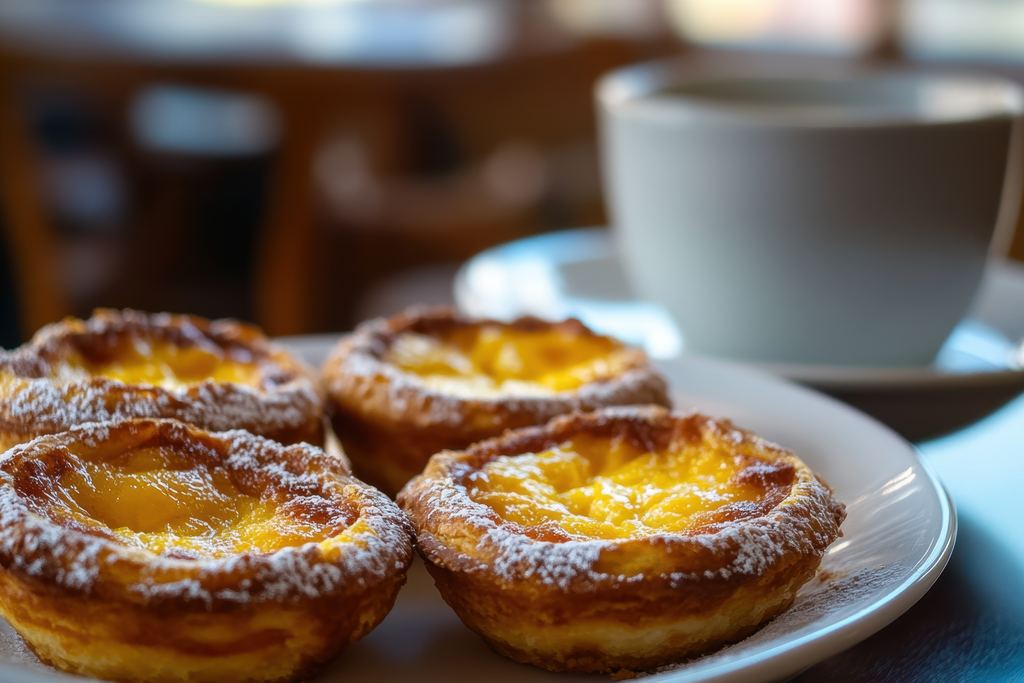
The pastel de nata and the monks of Belem: the chronology fits, the tradition of convent sweets is real, and there is no archive. The egg cream: Louis Auster's own grandson said the origin of the name was lost, and the two candidates are Yiddish echt and a mangled chocolat et creme. The gilda of San Sebastian, supposedly named for the 1946 film because it is salty, green and a little spicy: charming, oral, unsourced. The tanjia as a bachelor's dish: the cooking method is thoroughly documented, the label appears almost only in English-language recipe headnotes and in no ethnography we could find. The francesinha: attributed to Daniel David da Silva at A Regaleira in 1953 by everyone, on the authority of recent newspapers. Pho and the pot-au-feu: a live dispute between a French and a Cantonese origin, so saying it comes from the pot-au-feu is taking a side. And the New York bagel: the city's water really is soft, at an average of 25 milligrams per litre according to the water authority's own report, but nobody has run the controlled test that separates the water from the high-gluten flour, the malt boil and the slow ferment.
When the honest answer is that nobody kept the receipt
The story of the Jeronimos monks selling their custard tart recipe after the religious orders were dissolved in 1834 is repeated on every Lisbon and Porto tour, and it may well be true. It is also, as far as we can establish, entirely undocumented outside company history.
That does not make it worthless. It makes it a tradition rather than a fact, and those are different things to hand a visitor.
How to hear a food story
Three habits have caught almost everything on this page. A story with a precise date and a named individual but no document behind it is usually a piece of marketing that hardened into folklore, and the more charming it is the harder you should press. A claim about an official recognition is worth thirty seconds with the actual register, which is public and searchable. And a dish presented as ancient is very often a nineteenth or twentieth century invention wearing a costume, because that is when national cuisines were being written down and standardised in the first place.
None of this should make a tour less enjoyable. A guide who says nobody really knows where the egg cream got its name is telling you something more interesting than one who does not know that nobody knows.
Questions people ask about these stories
Is the pizza margherita really named after the queen?
It rests on a single document whose authenticity has been challenged, and the story does not appear in print until long after 1889. Neapolitan pizzerias were topping pizzas with tomato, mozzarella and basil before the visit. Treat it as a nice story with a weak foundation rather than an established fact.
Which countries on this site have a UNESCO food listing?
Mexico (2010), Japan (2013), Italy for the Neapolitan pizzaiuolo's craft (2017), Morocco jointly with three other countries for couscous (2020), and Peru for the practices around ceviche (2023). In each case the register describes knowledge and how it is passed on, not the quality of the food.
Does it matter if a food story is untrue?
Not much, if it is told as a story. It matters when it is used to justify a price, to declare one version authentic and another fake, or to tell you that a dish must be eaten in one particular way. A surprising number of authenticity rules turn out to be about a century old.
Why do so many origin stories point to one restaurant?
Because restaurants have an incentive to keep records of their own claims and no incentive to keep anyone else's. Archival work almost always finds an earlier and less tidy version, as happened with both Lombardi's and the dim sim.
Data verified on. UNESCO entries read on the Representative List; the pizza specification in Regulation (EU) 97/2010 and the pisco entry in Regulation (EU) 1065/2013 on EUR-Lex.
The words behind the stories
Most of the terms in this article, and about a hundred and thirty more, are explained in the glossary.