
The best-ranking article on this subject treats a peanut allergy, lactose intolerance, vegetarianism and a religious dietary law as four examples of the same thing. They are not the same thing, and running them together is why almost all the advice out there is useless.
An allergy is a medical event with a dose response and an emergency treatment. A preference is a decision you have made and can unmake at a stall in Bangkok if you want to. Both deserve to be taken seriously by an operator. Only one of them turns a food tour into a hospital visit. This page keeps them apart the whole way through.
What the law already gives you, at least in Europe
Almost nobody tells travellers this, and it changes how you ask. Under EU Regulation 1169/2011, allergen information is mandatory for food sold without prepackaging. That is article 44, and it applies across the food chain to what the regulation calls a mass caterer, defined to include, in its own words, a vehicle or a fixed or mobile stall.
So in Rome, Florence, Naples, Porto, Athens and San Sebastian, the trattoria and the street stall are both legally obliged to tell you whether a dish contains one of the listed allergens. Asking is not an imposition. It is the thing the rule exists for.
Two limits worth knowing, because they are the ones people get wrong. The obligation is to inform, not to guarantee an absence: nothing in the regulation requires anyone to prevent cross-contact between a fryer and your dish. And the regulation leaves each member state to decide how the information is given, so it may be on a menu, on a sign, or only when you ask. Outside the EU there is no equivalent you can rely on, which is exactly where the rest of this page matters most.
What the catalogue actually declares
We counted across all 429 experiences on this site, looking at the operator's own text rather than at a filter. The picture is thinner than the marketing suggests.
| Term appears | Listings | Share |
|---|---|---|
| Vegetarian | 158 | 37 per cent |
| Gluten | 103 | 24 per cent |
| Allergy or allergen | 93 | 22 per cent |
| Vegan | 77 | 18 per cent |
| Lactose | 21 | 5 per cent |
| Pescatarian | 8 | 2 per cent |
| Kosher | 8 | 2 per cent |
| Halal | 5 | 1 per cent |
| Nut allergy specifically | 1 | under 1 per cent |
Read that last row again. One listing out of 429 mentions nut allergy by name. And a mention is not an accommodation: several of the listings that name a diet do so in order to say no, with wording like no gluten-free options and no vegan options sitting in the exclusions.
The honest summary is that silence is the norm, and silence is not a yes. If a listing says nothing about diet, assume nothing has been arranged.
The refusals are more informative than the acceptances
We went through the published policies of the best-known independent operators, and the useful finding is how willing the good ones are to say no. That is a mark of seriousness rather than the opposite.
On coeliac disease, Culinary Backstreets writes that it cannot accommodate gluten-free or dairy-free diets on its Naples walk and that this applies to all of its Naples walks. Devour points out that a pasta making class is, by its nature, not suitable for coeliacs, and nor is the pizza part of its Rome tour. An operator in Naples offers gluten-free alternatives only on private tours. Against that, one Mexico City operator states that every stop on its tours is gluten-free, which is a claim about the cuisine as much as the company: maize is not wheat.
On vegan diets, the refusals are close to systematic in some cuisines. Culinary Backstreets does not recommend any of its Naples walks for vegans, and gives the reason plainly: the cooking is built on dairy, eggs and meat. A Mexico City operator explains that street food items are cooked alongside non-vegan ingredients and that it cannot work around that.
On vegetarian diets, the answer is usually yes with one caveat repeated almost word for word across companies: vegetarian items often share the same cooking surface as meat. If that is a preference, fine. If it is a religious requirement, it is not.
And on severe allergies the industry steps back, in language that is uncomfortable to read and better than a false reassurance. Eating Europe writes that guests with severe or life-threatening allergies cannot participate. Devour recommends that guests with severe food allergies avoid taking a food tour at all. A Tokyo operator states that cross-contact is possible and that it cannot make a guarantee, because the food is prepared in kitchens it does not control.
An operator that tells you it cannot keep you safe is being more responsible than one that promises it can. The food is cooked in somebody else's kitchen, on somebody else's surfaces, by somebody who does not work for the tour company.

Say it three times, to three different people
Declare it at booking, because that is when a tour can be re-routed. Declare it again at the meeting point, because the guide is very often not the person who read your booking. And check at each stop, because the person cooking has been told by the guide, in a second language, over noise.
None of this is distrust. It is how information actually survives three handovers.
How much notice they actually want
Most operators say at booking or in advance without a number. Where a number exists it is one of two: 48 hours, which is what Culinary Backstreets asks for by email with the specifics, or one week, which is what a Tokyo operator and a Mexico City operator both ask for.
Treat one week as the safe assumption for anything medical, and understand what the notice is for. It is not paperwork. It is time to call a stallholder and change a stop.
Which cuisines are hard, and why
This is the part that decides your trip more than any operator policy does, and it is rarely written down anywhere.
| Cuisine | Vegetarian | Vegan | Gluten-free | The specific trap |
|---|---|---|---|---|
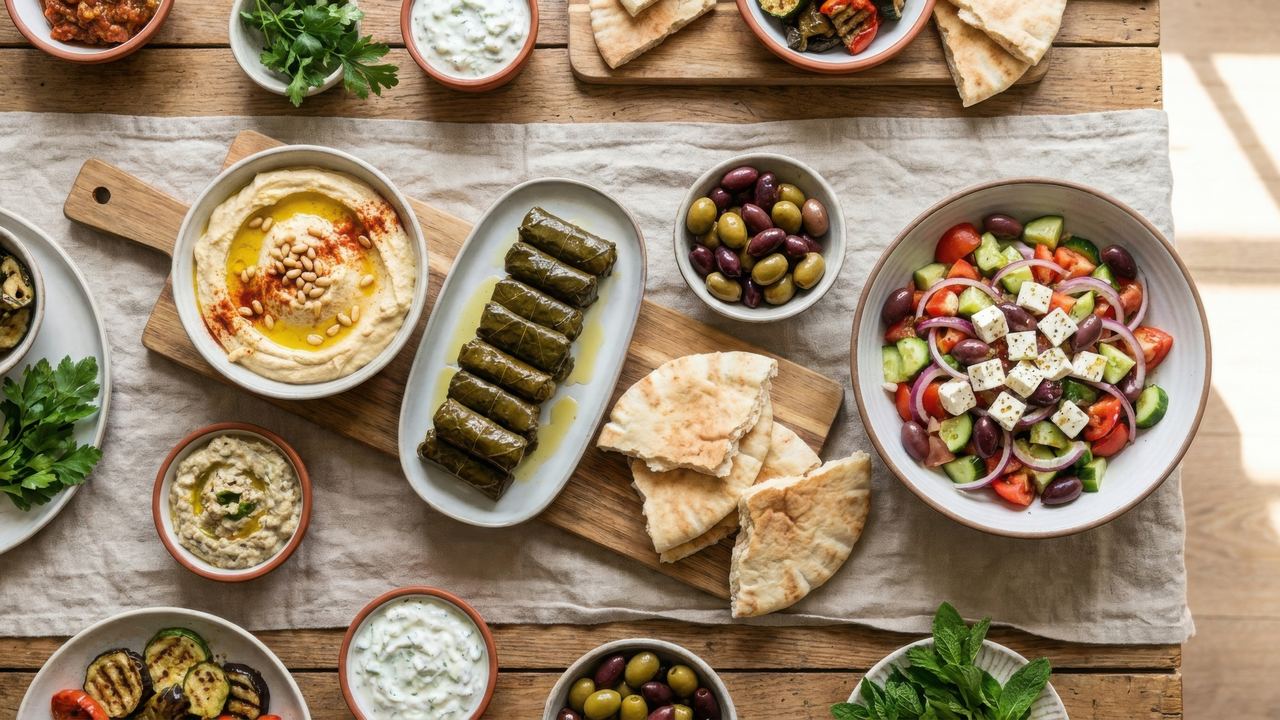
| Greek | Very easy | Easy | Moderate | None, really. Orthodox fasting has produced a whole repertoire of dishes with no animal products at all, and every taverna knows them |
| Mexican | Easy | Moderate | Very easy | Chicken stock in vegetable dishes, and lard in beans and pastry. Maize means gluten is rarely an issue |
| Italian | Easy | Hard | Moderate | Coeliac disease is well understood in Italy, but a pasta or pizza class is not adaptable |
| Peruvian | Moderate | Moderate | Easy | Fish is everywhere, including in dishes that look vegetable. Potatoes and maize keep gluten low |
| Moroccan | Moderate | Moderate | Hard | Bread is the utensil. Vegetable tagines are common and often cooked in meat stock |
| Spanish | Hard | Hard | Moderate | Ham is treated as a seasoning rather than a meat, and appears in things described as vegetable |
| Portuguese | Hard | Hard | Moderate | Same as Spain, plus salt cod in places you would not expect it |
| Thai | Moderate | Hard | Moderate | Fish sauce in almost everything savoury, salads included. Soy sauce carries wheat |
| Vietnamese | Moderate | Hard | Easy | Fish sauce again, and pork broth under noodles that look vegetarian. Rice noodles help |
| Japanese | Hard | Very hard | Hard | Dashi, made with dried bonito, is the base of most savoury cooking. Soy sauce contains wheat |
| Australian and American | Very easy | Very easy | Very easy | Nothing structural. Labelling and awareness are strong |
Two of those deserve a sentence more. Greece is the easiest country in Europe to eat well in as a vegan, and the reason is religious: the Orthodox fasting calendar removes meat, dairy and eggs for a large part of the year, so nistisima dishes are a normal part of every taverna's repertoire rather than a special request. Ask for the fasting dishes by name and you will be understood.
Japan is the hardest, and for a reason that catches out even careful travellers: dashi. It is in the miso soup, the simmered vegetables, the dipping sauce and the egg. A dish can be entirely plant-based on the plate and built on fish in the stock.

The card in your pocket
For a serious allergy, a written card in the local language is the single most effective thing you can carry, and it works because it removes your accent, the noise and the guide's second-hand summary from the chain.
We are deliberately not printing translated phrases on this page. A subtly wrong translation of a medical sentence is worse than none, and we are not in a position to guarantee ours for eight scripts. Use a professionally produced card: several organisations and apps produce them, reviewed by native speakers, for exactly this purpose.
What a good card contains, whoever makes it:
The allergen named in the local language, including its common local forms, which is the part machine translation gets wrong. Nuts are the classic case, because a card that says nuts may not cover a specific paste or oil in the local vocabulary. Then a clear statement that even a trace can cause a serious reaction, because in most places a request without that sentence is read as a preference. Then a direct question about the cooking surface, the oil and the fryer rather than the recipe. And finally what to do, in the local language, if something goes wrong. In the European Union the emergency number is 112 everywhere, which is one fewer thing to look up.
The word to use with a professional kitchen is cross-contact rather than cross-contamination. It is the term allergy specialists use, and it separates your question from a general one about hygiene.
If the answer is no
It sometimes will be, and a straight no from a serious operator is worth more than a vague yes from an unserious one. Three things to do with it.
Ask about a private departure. This is the most common workaround in the industry and several operators say so outright: a gluten-free route exists, but only when the group is yours. Fifty-six of the experiences here are private.
Switch format. A cooking class is often easier than a walk, because there is one kitchen, one cook and a shopping list rather than eight stalls. A market tour is easier still, since you buy what you choose.
Get the cancellation in writing before you pay. If the operator later cannot accommodate you, you want that exchange on record. Remember that a dated leisure booking has no fourteen day cooling-off right in the EU, so the refund you get is the one the seller offers, not one the law provides.
Questions people with dietary needs actually ask
Can I do a food tour with a severe nut allergy?
Several major operators say you should not, and they say it in writing. The food is cooked in kitchens they do not control, cross-contact cannot be excluded, and a guide cannot supervise eight separate stalls. A private tour or a cooking class, arranged a week ahead with the allergen named in the local language, is a far better structure than a group walk. Carry your own medication and do not rely on anyone else's assurance.
Is vegetarian enough to say, or should I list things?
List things. In several of these countries vegetarian is understood to permit fish, and sometimes chicken stock. Saying no meat, no fish, no chicken stock is longer and works. The same applies to vegan, where the reliable phrasing is no dairy, no eggs, no honey.
Which country is easiest if I do not eat meat?
Greece, comfortably, because the Orthodox fasting tradition has built a whole category of dishes without animal products and every kitchen knows them. Mexico is next, provided you ask about chicken stock and lard.
Do operators charge extra for a dietary version?
Not usually on the tour itself, though several will only do it on a private departure, which costs more. One large operator states that it does not discount for non-drinkers, and the same logic applies to food: you pay for the tour, not for the plates.
What if I only find out on the day?
Tell the guide immediately, before the group moves. You will probably miss some stops rather than the whole tour. What you will not get is a refund, because the notice period existed for a reason and you are inside it.
Data verified on. Counts taken from the operator text of the 429 experiences on this site. Allergen obligations from Regulation (EU) 1169/2011 on EUR-Lex; operator policies quoted from their published pages.
The other half of eating safely abroad
What the health agencies actually recommend about street food, and which famous rules the evidence does not support.