
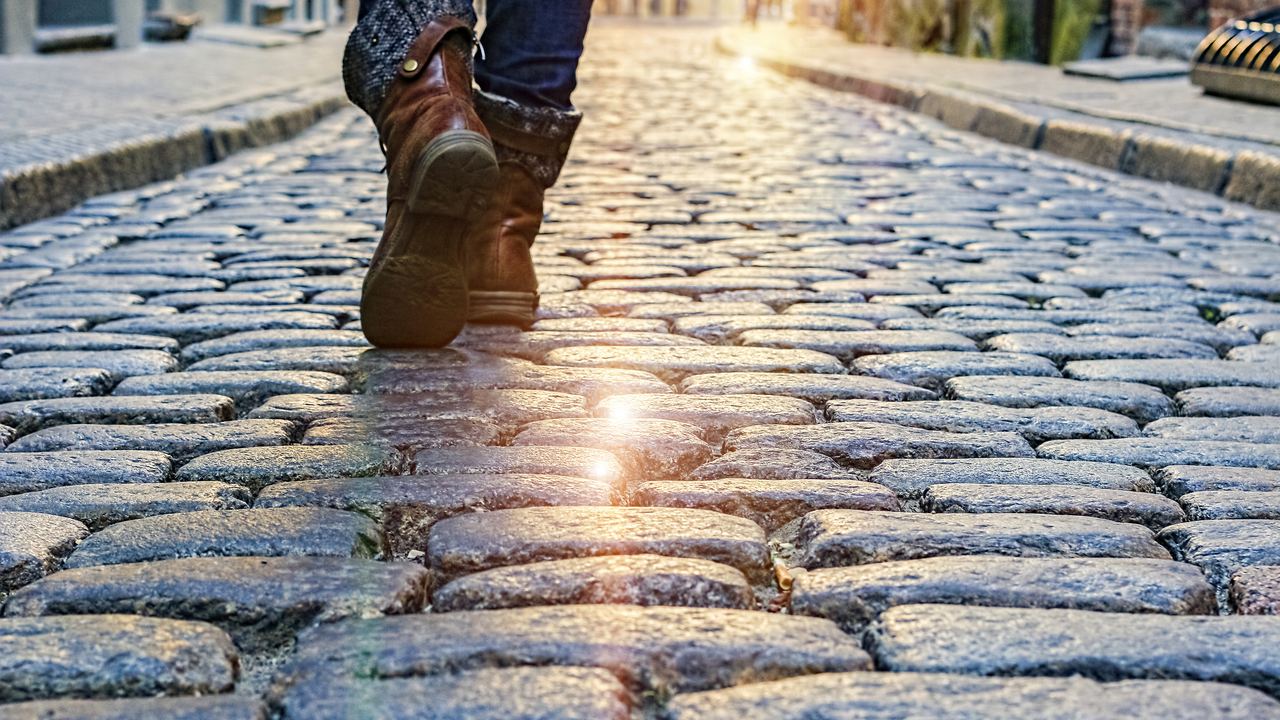
Wear comfortable shoes is the advice every operator gives and it is close to useless, because it does not tell you the thing that actually makes a food tour tiring. You are not walking far. Across the two companies in the world that publish a distance, a city food walk covers between one and a half and two and a half kilometres, and one of them notes that you are only actually walking for twenty to thirty per cent of the time.
The rest of it you spend standing still, on stone, at a counter with no chair, holding a plate. That is a different problem from walking, and it wants different shoes.
Shoes, and the one rule that covers everything
Cushioning beats support here. Three hours of standing on a hard floor is what wears people out, and a stiff walking shoe designed for distance is worse at it than a soft-soled one. Whatever you choose, it needs a closed toe, because you will be in markets where things are dropped and in kitchens where things are spilled, and a flat sole with some grip, because the wet cobbles of Porto and the tiled floors of a Lima market are both slippery in the same unhelpful way.
Two specifics that catch people out. Japan: wear socks you would be happy to be seen in, because a number of the best small restaurants have raised tatami floors and you will take your shoes off at the door. Slip-ons are worth it for the same reason. And anywhere with cobbles, which is most of Europe on this site, a narrow heel of any height will find every gap.
What to actually carry
The bag should go across your body and leave both hands free, because you will be holding a plate and a glass at the same time more often than you expect, and because in busy markets a bag on your back is a bag you cannot see. Everything below fits in a small one.
| What | Why | How much |
|---|---|---|
| Cash, in small notes | Street stalls and market vendors often cannot change a large note, and some cannot take cards at all | Enough for two or three extra purchases, in the smallest denominations you can get |
| Water | You will be given wine and coffee and very little water. Most of the dehydration on a hot tour is self-inflicted | Half a litre, refillable where the tap is safe |
| Hand sanitiser or wipes | You will eat several things with your hands, standing up, without a sink in sight | A small bottle |
| A layer | Evening street food tours finish after dark, and a city that was 30 degrees at six is not at ten | One light layer, packable |
| Sun protection | Market tours are outdoors, at midday, in Marrakech, Athens, Bangkok and Lima | Hat and sunscreen from May to September, or year round in the tropics |
| Antacid | Nobody writes this down and everybody thinks about it around stop six | Two tablets, and you will probably not need them |
| Your phone, charged, with the meeting point pinned offline | The commonest way to miss a tour is not finding the start. Grace periods are five to ten minutes | Screenshot the map, do not rely on a signal |
| Any medication you would need in an emergency | Especially if you have a food allergy. Nobody on the tour will be carrying yours | As prescribed, on your person and not in a hotel room |
And one thing to leave behind: strong scent. If any part of your day involves a wine cellar, a port lodge or a coffee cupping, perfume and aftershave are genuinely disruptive, to you and to everyone standing next to you. It is the one etiquette rule in this whole section that has a physical reason behind it.

Cash, and where it still decides what you can buy
Cards are accepted almost everywhere in Italy, Spain, Portugal, Greece, urban Japan, the United States and Australia, and you can run a whole trip without notes.
At street level the picture changes. Market stalls and pavement kitchens in Vietnam, Thailand, Morocco, Mexico, Peru and Colombia still work in cash, and so does the guide's tip almost everywhere. Carry small notes: a large one at a stall selling two-euro portions is a problem you have created for somebody.
Dress codes that are not obvious until somebody stops you
Food tours pass through places with rules. None of these is about looking smart, and all of them are about being allowed in.
Rome, Florence and Athens. Churches require covered shoulders and knees, and this is enforced at the major ones rather than merely requested. A Rome food walk in the centre will pass several, and if the tour includes a church stop, or if you plan to duck into one between stops, a scarf or a light layer solves it in two seconds.
Bangkok. Same rule at temples, applied more strictly, and it covers everyone. Sarongs are usually available to borrow at the entrance but the queue for them is not a good use of an afternoon.
Marrakech. There is no rule and there is a strong convention. Covered shoulders and knees, particularly in the medina and particularly for women, attracts markedly less attention and makes the souks a more comfortable place to spend three hours. Lightweight and long is also the cooler choice in that heat, which is the part visitors find counterintuitive.
Japan. No dress code worth mentioning, but two habits: shoes off where the floor is raised, and eating while walking is still frowned on in many places, which is why a street food stop there means standing beside the stall rather than moving on with the food.

Dressing for the weather you will actually be standing in
Every operator we checked runs its tours rain or shine, in those words, and nobody offers a weather refund. One company in Bangkok hands out ponchos, and that is the extent of the industry's provision. So the weather is your problem, and the relevant question is not what the temperature is but what you will be doing in it: standing outdoors, mostly still, for three hours.
That changes the calculation. Standing still in 12 degrees is colder than walking in 8. Standing in humid heat is worse than walking in dry heat, because nothing is moving air past you. Four situations are worth planning for specifically.
Humid heat, in Bangkok, Hanoi, Hoi An and Lima's summer. Loose natural fibres, and a second shirt if the tour runs into the evening. Cotton that is wet at four is unpleasant at seven.
Dry heat, in Marrakech, Athens, Rome and Florence in high summer. Cover up rather than strip off, drink more than you want to, and prefer a morning or evening departure over a midday one.
Rain that arrives on schedule, in Mexico City's wet season and in Southeast Asia's, where it tends to come in the afternoon and pass. A small folding umbrella beats a waterproof jacket, because the jacket is unbearable in the humidity that follows.
Cold that gets into a standing group, in New York and Melbourne, and in northern Europe outside summer. Layers, and something for your hands, because you will be holding cold plates and a cold glass. Our page on when to go has the month-by-month picture for all sixteen cities.
Preparing the rest of you
Do not eat beforehand. This is the single most consequential piece of preparation and it is covered properly on what actually happens on a food tour. Short version: tasting starts within ten minutes of the meeting point, operators are unanimous that you should come hungry, and one large company advises that if you must eat, keep it to a light snack.
Decide about alcohol before you start. On European tours drinks are usually included whether you drink them or not, and there is no discount for skipping them. Telling the guide at the meeting point that you are drinking little means the pouring quietly stops, which is easier than declining four times in front of a group.
Tell them about the diet again. You told the booking form. The guide standing in front of you may not be the person who read it. Thirty seconds at the meeting point is the cheapest insurance on this list, and there is a whole page on allergies and dietary needs.
Arrive twenty minutes early, not five. Guides leave within five to ten minutes of the start time and several operators state plainly that traffic is not a circumstance they compensate for. Twenty minutes buys you a coffee and removes the only real risk in the whole day.
The four things people wish they had brought, in order: smaller notes, a layer, water, and something to settle a stomach. The four things they wish they had left behind: a big camera, a backpack, heels, and perfume.
Practical questions
Do I need to dress up for a food tour?
No. Every format on this site is casual, including the wine ones, and you will be standing in markets and on pavements. The only places with a real code are churches and temples, where covered shoulders and knees are required, and that is about access rather than smartness.
How much cash should I bring?
Enough for two or three extra purchases plus a tip for the guide, in small notes. The tour itself is paid for; the cash is for the thing you want to buy at stop four and for the tip, which is almost never included and almost never taken by card.
Is a backpack a problem?
In a crowded market, yes, for two reasons: you cannot see it, and it takes up the space of another person in a narrow aisle. A small crossbody bag is better on both counts and leaves your hands free, which matters more than it sounds when you are holding a plate and a glass.
What if it rains?
The tour goes ahead. Every operator we checked says rain or shine, and no refunds are offered for weather. Bring a small umbrella rather than a heavy jacket, especially anywhere humid.
Anything specific for a cooking class?
Tie long hair back, skip anything loose-sleeved, and expect to be standing at a counter for most of it. Some kitchens provide aprons and some do not, so do not wear something you would mind marking.
Data verified on. Walking distances and weather policies quoted from operators' own published pages. Dress conventions described as observed practice, not as rules, except where entry is genuinely refused.
Then there is what you put in your stomach
What health agencies actually recommend about street food, and which of the famous rules the evidence does not support.