Twelve People, or Twenty Thousand: What Food Tour Group Size Declares and What It Hides
One Naples pizza class declares a maximum of 20,000 people and another 9,999. We read all eighteen listings on that page and counted the ceilings: they run from ten to thirty, two contradict their own booking field, and one calls twenty a small group.
The field that declares food tour group size is optional, and on one pizza class in Naples it says 20,000. On another it says 9,999. Nobody in Naples is expecting twenty thousand people around a bench with a bag of flour. The operator left the box empty, and the booking system put a placeholder in rather than publish nothing.
That is funny for a second and then it is useful, because it tells you what a listing is. Not a description: a form somebody filled in, with the dull boxes left to the machine. And the box in question is not a dull one. The number that decides what a food tour is like is not the price. It is how many people are standing next to you at the counter, and whether the chef can reach all of them.
What food tour group size looks like across 429 listings
Across the 429 experiences on this site, 373 declare a maximum and the median is twelve, counted on 5 September 2026. Fifty-six are private. That median is the useful half of the answer: twelve people is a group you can still hear over, and one a small place will still seat.
The other half is that the field is not reliable, and the two Naples classes prove it in the rudest way available. Our guide to reading a listing goes through the wider distribution and the other fields worth checking. This piece does something narrower: it takes the page where those two absurd numbers live, and reads every listing on it.
20,000. 9,999. Two pizza classes in the same city, declaring a ceiling nobody could seat, because the field was left empty and something had to go in it.

We read all eighteen listings on the page where those two numbers live
On 23 September 2026 we opened every listing on the Naples pizza class page. There are eighteen, priced from €24.01 to €150, and all eighteen declare a ceiling in the same place: a line in the booking details reading up to 30 travelers per booking, or ten, or whatever the number is. It runs from ten to thirty.
| Ceiling per booking | Listings | Price range | What the listing text says |
|---|---|---|---|
| 10 | 3 | €24.50 to €150 | All three say ten. One is a private class in a private house |
| 12 | 2 | €58.99 to €69 | Both say twelve |
| 14 | 2 | €79 to €115 | One says ten. One says eighteen |
| 15 | 6 | €32.24 to €99 | All six say fifteen |
| 25 | 1 | €36.75 | Says twenty-five |
| 30 | 4 | €24.01 to €65 | Two say thirty. Two say nothing |
The median of those eighteen ceilings is fifteen, three higher than the catalogue median. The spread is the part worth looking at: on one page, under one heading, where every product is sold as the same afternoon, the declared ceiling varies by a factor of three. The price does not tell them apart either. The cheapest class on the page carries one of the highest ceilings, and the most expensive carries one of the lowest.
Two of the eighteen say nothing at all about numbers in their own description. One of those two is the most booked thing on the page, with 3,651 reviews. Its booking line says thirty.
Food tour group size is not the same as travellers per booking
This is the part almost nobody separates, and it matters more than the placeholder story.
There are two different ceilings in the booking data behind a listing like this, and they answer different questions. One is the maximum number of travellers in a shared tour, which is the group size in the sense you mean when you ask. That is the field left blank on the two Naples classes, which is why 20,000 came out of it. The other is the maximum travellers per booking: how many people you can put on a single reservation. That is the number quoted on all eighteen listings on this page.
Read the second as though it were the first and you will be wrong in both directions. A line saying up to 30 travelers per booking is not a promise that thirty strangers will be there. It is also not a promise that they will not be. It tells you how large a party the operator will take in one transaction, which is useful if you are eleven people at a wedding and useless if you are two people wondering how crowded the bench will be. Our glossary of booking language has the rest of the vocabulary that gets used loosely.
Three listings that show the problem
All three are on the same page, sold under the same heading, read on the same day.
Three numbers, one listing
The Pompeii day with a pasta class afterwards declares up to fourteen travellers per booking. Its description says the guided walk runs in a group of no more than eighteen. Its list of inclusions calls the same walk "small group max 20 People". The largest of the three numbers is the one wearing the words small group.
The cap is the product, and the field says otherwise
One class sells itself on its ceiling: ten at the bench, semi-private, so the chef can stand behind every pair of hands while the dough is opened. It costs €79, more than triple the cheapest class on the page. Its booking line says fourteen.
No number at all
The most reviewed class on the page, 3,651 reviews at 4.9 stars, names no ceiling in its description. The booking detail says up to thirty per booking. Thirty is not a bad class. It is a different purchase from ten, and you have to know which field to read to find out which one you are buying.

On this page, the ceiling is most of what you are paying for
Paying more does not reliably buy a smaller class. The cheapest listing on the page, at €24.01, takes up to thirty per booking, while the second cheapest at €24.50 says ten. But the small ceilings cluster at the expensive end: the three priciest listings on the page declare ten, fourteen and ten, and the €150 one at the top is four hours on Ischia, cooking from a family's own handwritten books, capped at ten.

What a cap buys, and what it does not
Across the whole catalogue 56 of 429 experiences are private, which is thirteen per cent. On this page two are flagged private and a third is sold as semi-private at €79.
The premium is real and smaller than people expect. What it buys is not access, because a cooking class is not gatekeeping anything: it buys the chef's attention and the pace of the room. That is the same thing the cap buys, at a higher price and with more certainty attached.
The cancellation line, and the minimum nobody reads
The second number people skip is at the bottom of the page. Of the 429 experiences here, 413 can be cancelled free until the day before, and fifteen cannot be cancelled at all: no refund, no date change. Six of those fifteen are cooking classes from one operator in Bangkok at the same price. The most expensive of them is a truffle hunt near Florence at €335, which we re-read on 23 September: eight people and a Lagotto Romagnolo into the woods above San Miniato.
The Naples page is the benign case, and that is worth saying plainly. All eighteen listings on it offer a full refund up to 24 hours before the start. The fifteen that refund nothing are concentrated somewhere else entirely, which is exactly why the line has to be read per listing rather than assumed from a category.
Then there is the minimum, which hardly anyone looks for and which one of these eighteen states outright: minimum two people per booking. A minimum is not a formality. It means the departure needs a second party to run, and if that party cancels, yours does not go ahead. The person who discovers this at short notice is usually the one travelling alone, who had no way to see the risk, because a minimum of two reads like a note about ticketing rather than a condition on whether the thing happens at all.
You do not have a right to cancel. You have a policy.
Most people booking online in Europe believe they have fourteen days to change their mind. On a dated food experience they do not, and the reason connects straight back to the group cap.
…the provision of accommodation other than for residential purpose, transport of goods, car rental services, catering or services related to leisure activities if the contract provides for a specific date or period of performance
In Italian law the same rule is article 59(n) of the Consumer Code. A cooking class booked for the fourth of March is a leisure service on a specific date, so the fourteen days were never there to begin with.
Recital 49 of the same directive gives the reason, and the reason is the interesting part: withdrawal is inappropriate where concluding the contract implies the setting aside of capacity which, if a right of withdrawal were exercised, the trader may find difficult to fill. The ten places at the bench are the capacity. The cap that makes the class good is the thing that removes your right to cancel it.
There is a corollary the European Commission states in its own guidance on the directive, and hardly anybody quotes: the exception is to be read narrowly, and it should not cover leisure contracts where capacity is not limited. A walk down a public street behind a guide sets aside no seat. On that reading, the field left blank on those two Naples listings is also the field the exception depends on.
None of which stops an operator being more generous than the law requires, and nearly all of them are. It means the free cancellation you are relying on is a commercial promise rather than a right, so it is worth reading instead of assuming. Whether the tour is worth booking in the first place is a separate question, and the answer differs by city.
How to read the pair before you book
Treat the two ceilings as two fields, not one. A number of travellers per booking is the size of party the operator will sell to, not the size of the group you will join. If a shared-tour maximum is quoted as well, that is the one to believe. If the number is absurd, the field was left blank.
Ask what the room holds, not what the page says. A ceiling of thirty in a professional lab with a workstation each is a different proposition from a ceiling of thirty in a working pizzeria at dinner service. The listings that name the venue let you make that judgement. The ones that do not are asking for trust.
Look for a minimum. One line, usually near the ticketing notes, and the only field that tells you whether your departure depends on strangers turning up.
Read the cancellation line as a policy. Twenty-four hours is the common shape in Naples and across this catalogue, the law gives you nothing on a dated experience, and the handful of listings that say all sales are final mean it.
The pair is the point. Group size decides what the experience is like; the cancellation line decides what happens when your plans move. Neither of them is the price, and both of them sit further down the page than the price does.
Questions people ask before they book
What is a normal food tour group size?
Twelve is the median across the 429 experiences on this site, declared on 373 of them and counted on 5 September 2026. On the Naples pizza class page the eighteen listings declare ceilings from ten to thirty, with a median of fifteen. Below eight you can be taken into places that would not seat a larger party; above sixteen you are usually eating standing up, or in venues set up for groups.
Does "small group" mean anything on a food tour?
Not as a defined term. One listing on the Naples page describes a guided walk of up to twenty people as a small group in its own list of inclusions. The threshold that matters is not six against twelve, it is the number above which a small place stops seating you, and that is a fact about the venue rather than about the wording.
Why does a food tour listing say 20,000 people?
Because the maximum group size field is optional and the booking system fills it with a placeholder when an operator leaves it empty. Two pizza classes in Naples publish 20,000 and 9,999 for that reason. It is not a promise and not a mistake in the ordinary sense: it means that particular number carries no information, and you should look for a cap in the description instead.
Can you cancel a food tour?
Usually, but as a matter of policy rather than right. On this site 413 of 429 experiences can be cancelled free up to the day before, and fifteen cannot be cancelled at all. The fourteen-day cooling-off period people expect does not apply: article 16(l) of the Consumer Rights Directive takes leisure services with a specific date out of the right of withdrawal.
Is a private food tour or cooking class worth the extra?
Fifty-six of the 429 experiences here are private, and the premium is smaller than most people assume. It is worth it for three or more people travelling together, for anyone with a dietary requirement to manage, and for families. For a couple, a well-capped group class is usually better value and better company, and on the Naples page the semi-private format at €79 sits between the two.
The Naples classes these numbers came from
Eighteen listings, ceilings from ten to thirty, all of them refundable to the day before.
A Prosecco, Two Pasta Shapes and a Tiramisù on Via Medina
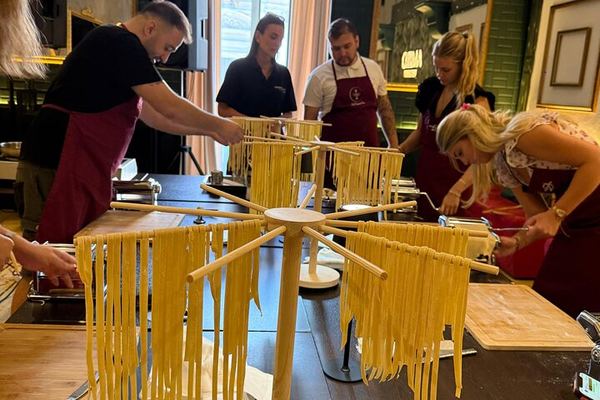
Ten people, an air-conditioned kitchen on Via Medina, prosecco and an appetiser to start. Two pasta shapes and tiramisù, then you eat them. Luggage stored free.
Bake Your Own Pizza, Then Churn the Gelato
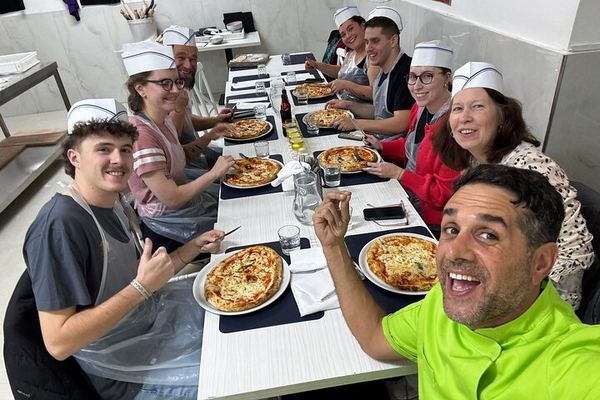
The shortest hands-on class in the Naplesbay lab: stretch and bake your own pizza, then churn gelato. Drink, apron and certificate included. From €41.60.
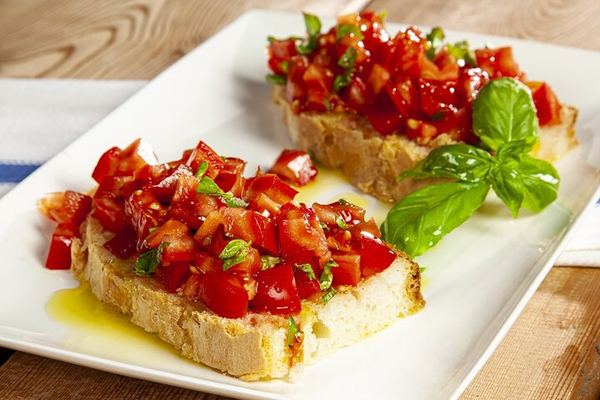
Cooking from the Family Cookbooks in Forio, Ischia
Wednesdays and Saturdays only: island recipes read out of old family cookbooks, cooked with what Ischia grows that season, at your own bench, with house wine.
Ratings collected by Viator and Tripadvisor
Data verified on. Catalogue counts measured on 5 September 2026. All eighteen listings on the Naples pizza class page, and the Florence truffle hunt, re-read on 23 September 2026.