

Naples Street Food Tours: the Quartieri and the Pignasecca
Fourteen walks, a median of 42 euros, and two and a half hours. Six of them state their duration in the listing, which is the highest proportion anywhere on this site.
These are the shortest and cheapest guided walks on the entire site, and they are also the most honest about it. Six of the fourteen state their duration plainly in the listing, at two and a half to three hours. Nowhere else does more than a fifth of a category do that, and it correlates with a market that has not yet learned to sell vagueness.
Four of them cost exactly the same amount, which raises the obvious question of how you choose.
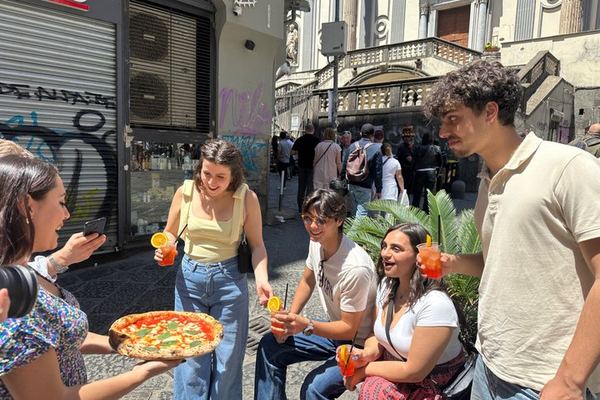
A Bakery Open Since 1837, and Gelato Under the Guglia
Mozzarella on Tribunali, fried pizza by the nativity workshops, frittatina on Spaccanapoli, pastries from an 1837 bakery, gelato under the guglia. €42.
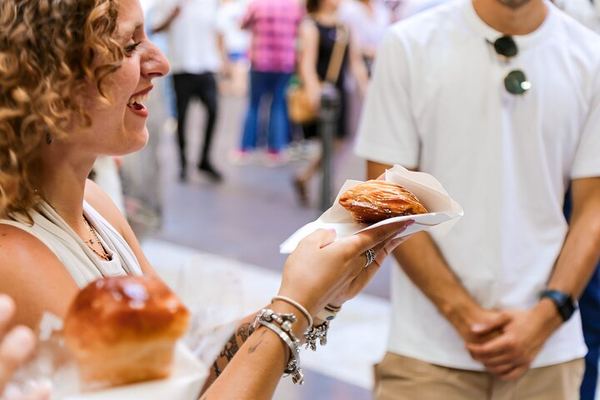
A Lucky Corno from San Gregorio Armeno, and Nine Stops
Three hours from the Duomo to Piazza del Plebiscito with tarallo, folded or fried pizza, baba and espresso, plus a red corno from San Gregorio Armeno. €59.
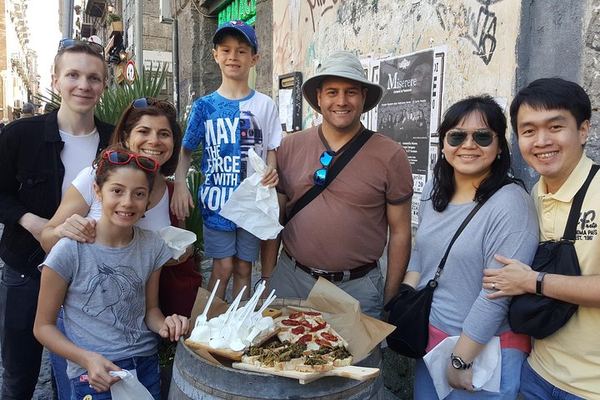
Arancini on Tribunali, Then the Deep-Fried Pizza
Two and a half hours from the Greek ruins at Piazza Bellini to Via Toledo, with arancini on Tribunali and deep-fried pizza as the last stop. €42, 15 places.
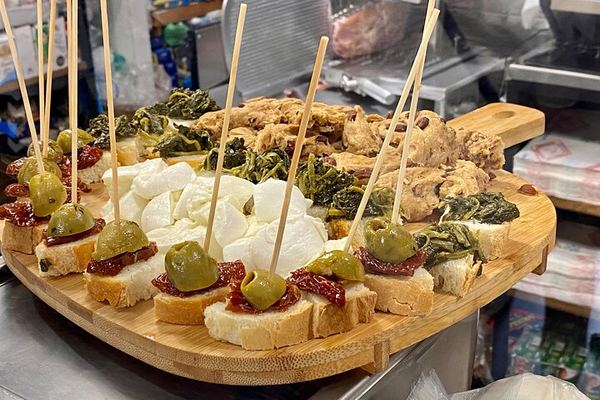
Fried Pizza on the Decumano, Mozzarella from 1958
Taralli by the Greek walls, mozzarella from a shop open since 1958, fried pizza on Via dei Tribunali, then sfogliatella and baba. Two and a half hours.
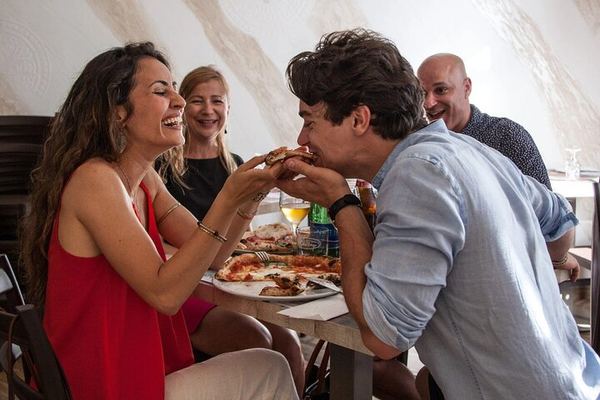
Frittatina at a Five-Generation Friggitoria, Then the Quartieri
Six tastings and three drinks across Galleria Umberto, a five-generation friggitoria and the Spanish Quarter. Twelve people maximum, three hours. From €80.10.
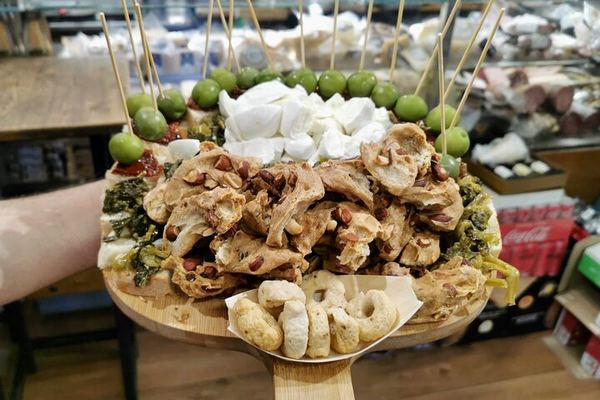
From the Greek Walls of Piazza Bellini to Via Toledo, Eating
Two and a half hours from Piazza Bellini's Greek walls through Tribunali and San Gregorio Armeno: buffalo mozzarella, pizza fritta, limoncello. From €42.
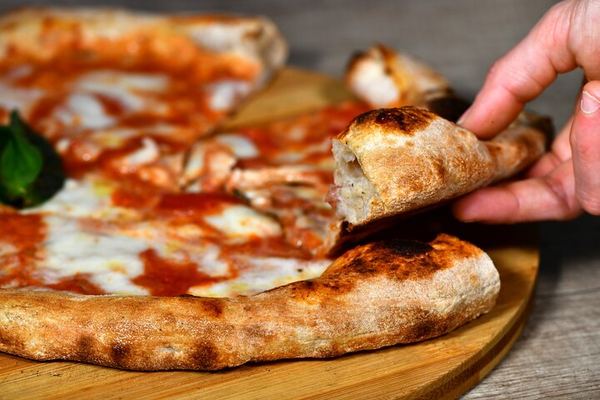
Margherita, Marinara and Pizza Fritta for Thirty Euros
Margherita at San Domenico Maggiore, Marinara alongside it, pizza fritta on Piazzetta Nilo, plus tarallo, frittatina and dessert by Santa Chiara. Twelve people.
Out from Piazza Bellini and Back in Two and a Half Hours
Two and a half hours out from the Greek walls and back to the same square, through pizzerias and suppliers you would walk past without a licensed local. €38.
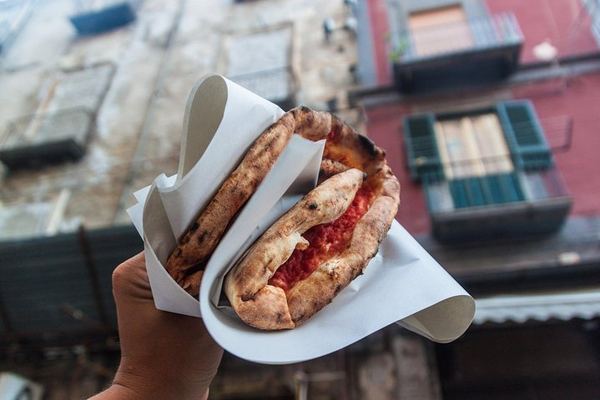
Taralli at Piazza Dante, Pizza a Portafoglio on Tribunali
Three hours from the Dante monument through the old centre, four stops that add up to a full meal: tarallo, frittatina, folded pizza, ragù, sfogliatella. €65.

Taralli at the Greek Walls, Dessert by the Conservatorio
Over ten samples in two and a half hours: tarallo at the Greek walls, mozzarella from a 1958 deli, fried pizza, limoncello, dessert by the Conservatorio. €38.
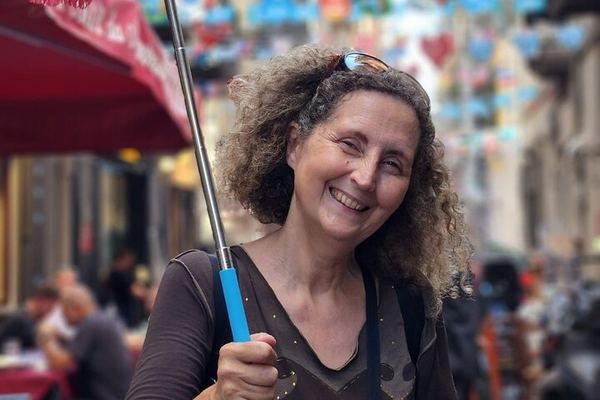
The Guide Is Included, the Food Is Your Choice
The one Naples walk where nothing is pre-ordered: your guide shows you the counters, you choose and pay, roughly €14 a head. Spaccanapoli to Plebiscito. €44.
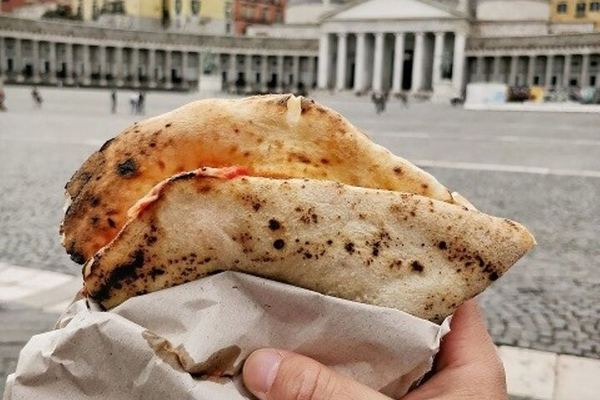
The Limonata a Cosce Aperte, Spaccanapoli and San Gregorio Armeno
Two hours from the Neptune fountain to Piazza del Gesù: folded pizza, tarallo with beer, sfogliatella, coffee and the lemon soda named after how you drink it.
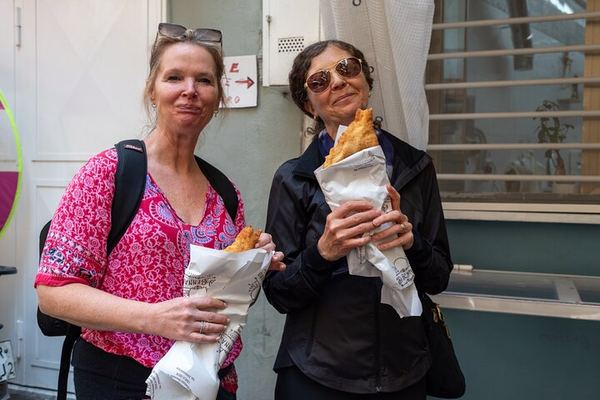
The Pignasecca, the Maradona Mural, and a Toast to the Sky
Three hours out of the tourist grid: market stalls, fried fish in a paper cone, fried pizza, the Quartieri, a glass at the Maradona shrine. Ten people.
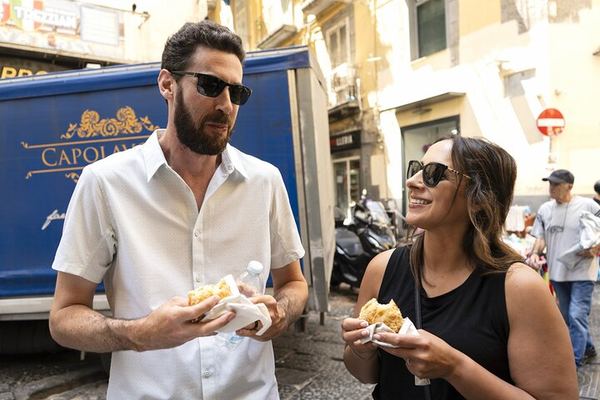
Two Hours in the Pignasecca, Ending at Scaturchio
Two hours around Naples' oldest market: spritz, taralli, frittatina, meatball in ragù, cuoppo of fried seafood, then Scaturchio for dessert. From €38.25.
Ratings collected by Viator and Tripadvisor
The glossary, which is most of the job
Neapolitan street food has its own vocabulary and almost none of it is guessable. This is the list these fourteen walks work through, in roughly the order a tour serves it.
| Name | What it is | Eaten |
|---|---|---|
| Cuoppo | A paper cone of fried things: small fish, courgette flowers, croquettes, vegetables | Walking, immediately, while it is too hot |
| Pizza fritta | A folded pizza, deep fried, filled with ricotta, provola and cicoli | Standing. Older and cheaper than the baked kind |
| Pizza a portafoglio | A whole pizza folded twice into a wallet | In the hand, for a couple of euros |
| Frittatina | A disc of bucatini bound with béchamel, breadcrumbed and fried | Two bites, and heavier than it looks |
| Panino napoletano | Bread dough baked with salami, cheese and egg inside it | Any time. Sold in bakeries by the piece |
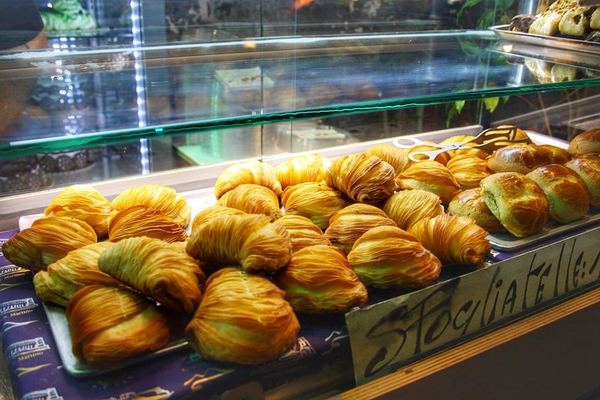
| Sfogliatella | Riccia, with dozens of crisp layers, or frolla, in short pastry | Warm, and preferably riccia |
| Babà | Yeasted cake soaked in rum syrup | After coffee, standing at the counter |
| Taralli 'nzogna e pepe | Ring biscuits with lard, pepper and almonds | With a beer, on the seafront |

The Pignasecca, and a warning about opening hours
The Pignasecca is the oldest market in Naples and it sits in the Montecalvario quarter, below the Quartieri Spagnoli. Matilde Serao described it in Il ventre di Napoli in 1884 and the trade has not moved since: fish on ice, vegetables, cheese, offal, and shouting.
Here is the thing worth knowing, and it applies to every Neapolitan market. No official source publishes their opening hours. The city's own documents list 07:00 to 15:00 against every market, which is the administrative window for the pitch concession rather than when the stalls are actually there. Guides work by experience, and any published hours you find, including ours, would be a guess. Go in the morning.
The sweet calendar, which is stricter than you think
Neapolitan pastry runs on a calendar, and outside their weeks several of these things simply are not made. It is the one part of the city's food that rewards knowing the date, and no tour description mentions it.
The sfogliatella and the babà are the constants, sold every day of the year. Everything else has a season, and in most cases a single day it belongs to.
| What | When | What it is |
|---|---|---|
| Sfogliatella and babà | All year | The two constants. Riccia in the morning, warm, is the version to have |
| Zeppole di San Giuseppe | 19 March | Choux fried or baked, custard and a sour cherry. The first written recipe is from 1837 |
| Pastiera | Holy Week, Easter | Wheat berries, ricotta and orange flower water, made days ahead to settle |
| Casatiello | Holy Week | A savoury bread ring with cured meats and whole eggs baked into the crust |
| Roccocò and mostaccioli | From 8 December | Hard spiced biscuits with almonds, the start of the Christmas season |
| Struffoli | Christmas | Small fried dough balls in honey, built into a ring |
| Graffe | Carnival, and often beyond | Potato dough doughnuts, sugared, eaten hot from the fryer |
Two practical notes. Pastiera is better on the second or third day, which is why Neapolitan families make it on Maundy Thursday and eat it on Sunday, and why a slice bought on Easter morning is not the dish at its best. And the roccocò is genuinely hard: it is meant to be dipped in wine or vermouth, and biting into one cold and dry is a mistake people make once.
Four tours, one price
Four separate listings on this page cost 42.00 EUR and two more cost 59.00. When six of fourteen products in a single city land on two prices, the market has settled: everybody knows what two and a half hours of walking and eight tastings is worth, and nobody is trying to win on price.
Which means the price cannot help you choose, and the ratings barely can either, since eleven of the fourteen sit between 4.8 and 5.0. Three things can.
The review count. It is very uneven here. The top listing has 2,727 and five listings have fewer than fifty. A tour with thirty reviews is not bad; it is untested.
The stated duration. Six say two and a half or three hours. The other eight say nothing, and in a category where being explicit is this common, silence is information.
The route. Some stay in the historic centre around Spaccanapoli, some go up into the Quartieri Spagnoli, and two are built around the Pignasecca. The Quartieri are the more interesting walk and the more crowded one.
What it costs without a guide
Naples is the city where this comparison is most stark, so it is worth setting out. A pizza a portafoglio is a couple of euros. A cuoppo is three or four. A sfogliatella is around two, a coffee at the counter about 1.20, and a sit-down margherita at one of the historic pizzerias 6.50 with a euro of cover charge. An entire day of eating your way through the old town costs less than the tour does.
So what is the 42 euros buying? The same thing it buys in Hanoi: the route, the order, the names of the things, and the confidence to do it alone tomorrow. In a city where a great deal of the good food is sold from a hole in a wall with no sign and no menu, that is a reasonable trade for one afternoon. It is not a reasonable trade for three.
The best value in Naples is one street food tour on the first day and a week of eating on your own afterwards. Every guide here will tell you the same thing, which is a point in their favour.
The practical bits
The fried food is genuinely hot. A cuoppo comes out of the oil into the paper and into your hand. Wait longer than you think.
Cash. The small places these tours use are the most likely in Italy to be cash only, and while it is included in your ticket, you will want some for the coffee afterwards.
The Quartieri Spagnoli are steep. They climb from Via Toledo in a grid of narrow streets, and two and a half hours of that with a full stomach is more walking than it sounds.
Scooters. They come through the narrow streets faster than you expect and from both directions. Guides say this at the start; it is worth listening to.
August. Several of the small places close for two or three weeks around the middle of the month. Tours run and substitute, but the route will not be the one in the reviews.
Questions about Naples street food tours
How long are they, really?
Two and a half to three hours, and unusually you can trust the listings: six of the fourteen state it explicitly, which is the highest proportion of any category on this site. These are the shortest guided walks we sell anywhere.
How much food is included?
Enough to replace a meal. Expect six to eight tastings across the walk, all of them fried or baked and none of them small by the standards of a tasting menu. Come hungry and do not plan dinner immediately afterwards.
Will the seasonal pastries be on my tour?
Only if you are here in their weeks. Sfogliatella and babà are made all year; zeppole belong to 19 March, pastiera and casatiello to Holy Week, roccocò and struffoli to Christmas. A tour in July will not show you any of those, and no operator can conjure them.
Is it safe to walk in the Quartieri Spagnoli?
They are busy, densely populated and full of people going about their day, which is the condition that matters. Ordinary city sense applies, particularly with phones in narrow crowded streets, and the tours use well travelled routes. The neighbourhood's reputation lags a long way behind what it is like to walk through now.
Which is better, this or a pizza class?
They cost about the same, at medians of 42 and 63 EUR. The walk shows you the city and gives you a vocabulary. The class teaches you dough in the place that wrote the specification for it. If you have one afternoon and have never been to Naples, take the walk; the food it introduces you to is cheap enough to keep eating all week.
Can vegetarians do this?
Reasonably well. The cuoppo is largely vegetables and courgette flowers if you ask, pizza fritta has a ricotta version, and the pastries are all fine. The obstacles are the fried fish and the cured pork in the panino napoletano. Say so at booking and most guides will simply reorder the stops.
Morning or evening?
Morning if the market is on the route, because that is when the Pignasecca works and nobody publishes reliable hours for it. Early evening otherwise, when the fried food shops are frying and the streets fill up. Avoid the middle of the afternoon, when much of the old town is shut.
Data verified on. Prices, ratings and stated durations read from the 14 listings on this page on 4 September 2026. The Pignasecca appears in Matilde Serao's Il ventre di Napoli, 1884.