
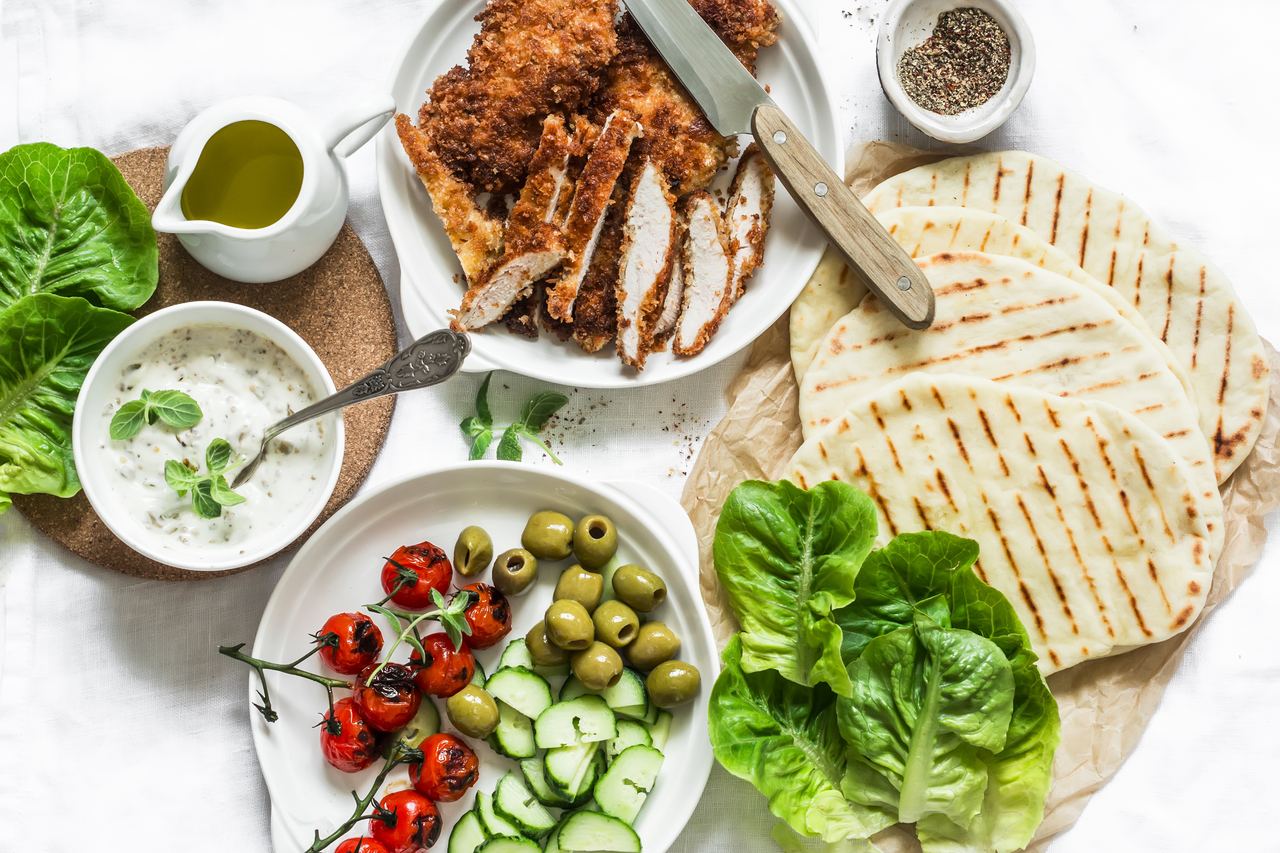
Greek Cooking Classes in Athens
Fourteen classes from 59 to 163 euros. Four are held with the Acropolis in view, which explains most of the price gap, and one teaches the only skill here you cannot learn from a video.
Fourteen classes, all of them rated 4.9 or 5.0, and a price range that more than doubles from bottom to top. What moves the number is not the syllabus, which barely varies, but the view: four of these are held on a rooftop or terrace within sight of the Acropolis, and you are paying for the sightline as much as the teaching.
The classes are also the more expensive half of the Athens catalogue, which is the opposite of Rome and Florence, and worth understanding before booking.
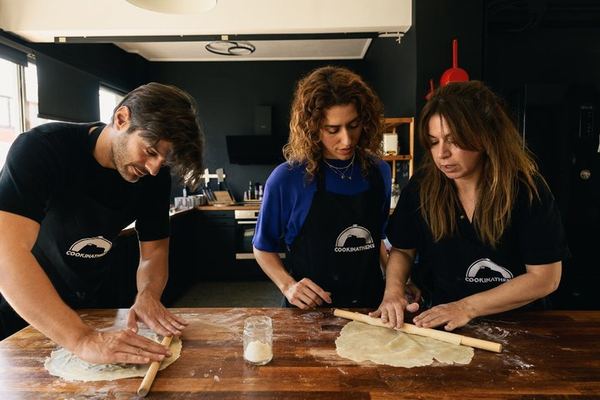
Athens Cooking Class in Pairs: Handmade Phyllo and Moussaka
Roll your own phyllo, then dolmades, tzatziki, Greek salad and moussaka or pastitsio, eaten with handmade sourdough and Greek wine, the Acropolis in view.
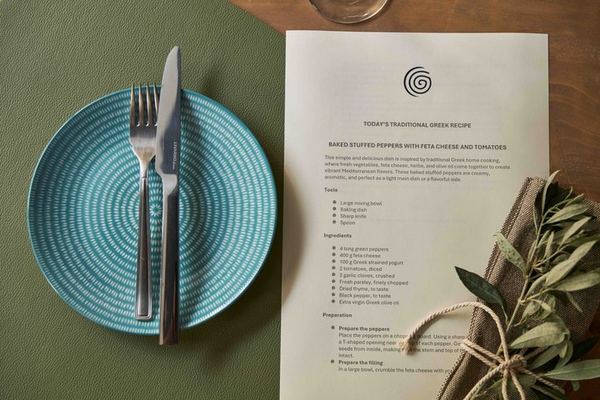
Athens Garden Cooking Class with a Home Cook and Transfer
Four and a half hours at a home outside the centre, cooking whatever the market gave up that morning, with unlimited wine and ouzo. Transfer from Monastiraki.
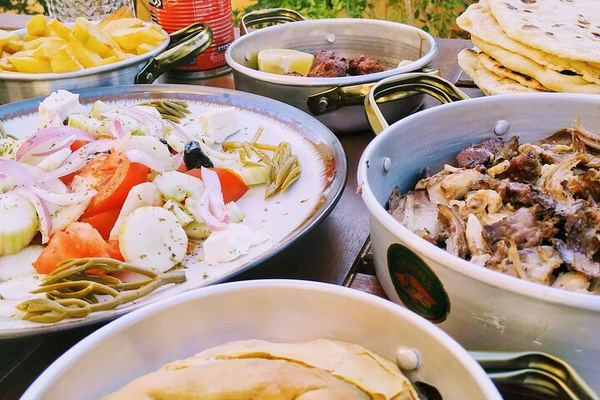
Athens Home Cooking Class: Pita Gyros Made from Scratch
Pita gyros built from nothing in a passageway kitchen off Panepistimiou, with vegetables bought that morning and a beer from the fridge while you cook.
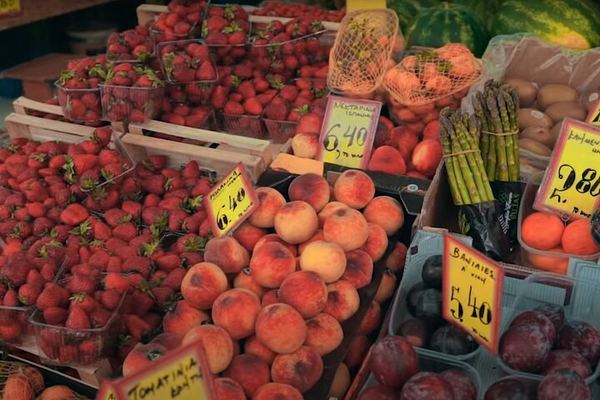
Athens Market Shopping and Taverna Cooking Class with Lunch
Shop the Central Market with the cook, then make tzatziki, dolmadakia, stuffed peppers and chocolate salami in a working neighbourhood taverna. Twelve places.
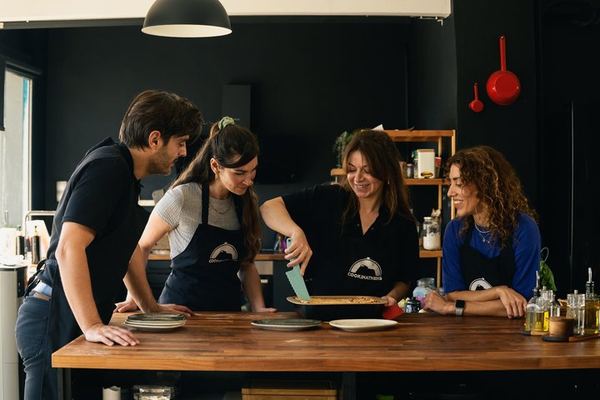
Athens Meze Cooking Class: Seven Small Plates and Phyllo
Seven meze dishes cooked in pairs in a loft above Evripidou, phyllo shaped by hand, then the whole spread shared at the table with plenty of Greek wine.

Athens Vegan Greek Cooking Class at the Soybird Studio
A plant-based Greek class in a ground-floor studio on Veikou, mains through desserts, with water, beer and white wine and the recipes sent afterwards.
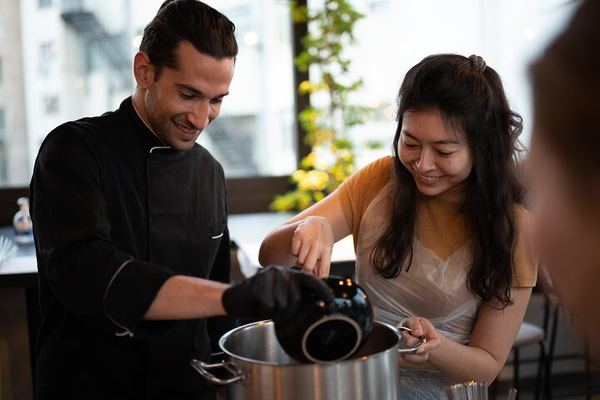
Chef-Led Greek Cooking Class at The Artist Athens
Four hours with a professional Greek chef four minutes from Athinas Street, cooking a full Greek menu and eating it under the Acropolis. Ten places.
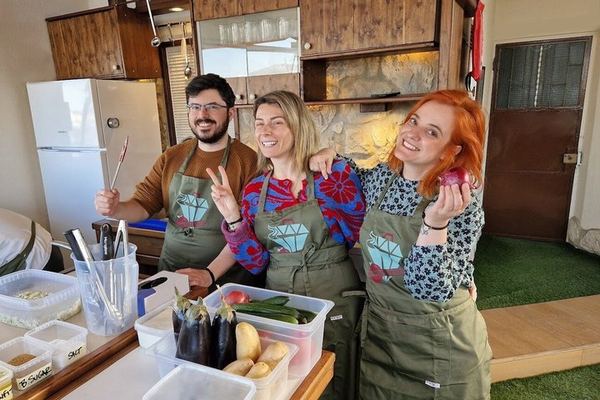
Diamond Roof Garden Cooking Class above Panormou, Athens
Six courses cooked on a sixth-floor roof garden over a residential Athens street, ten minutes from Panormou metro. Nine places, chef-led, wine included.
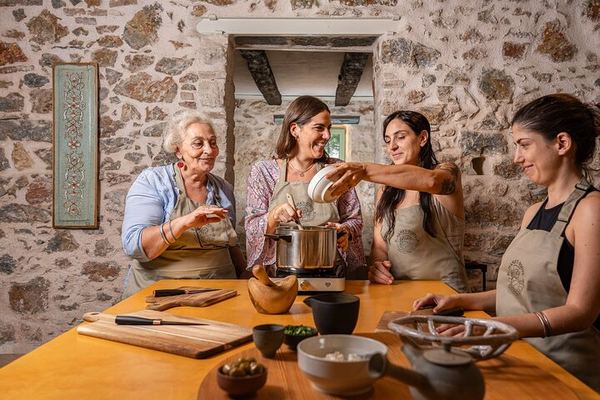
Mama's Roots Cooking Class in Athens: Six Dishes in a Garden
Six dishes from Cretan and Peloponnesian family recipes, cooked with garden herbs and vegetables in a Keramikou garden, then eaten with local wine.
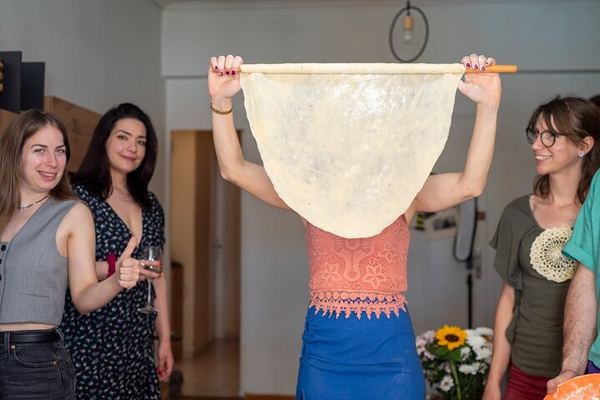
Phyllo Making with Christina in a Vironas Home Kitchen
A private lesson in hand-rolled phyllo from a cook who learned it from her grandmother and perfected it in a bakery, then a seasonal meal at her table.
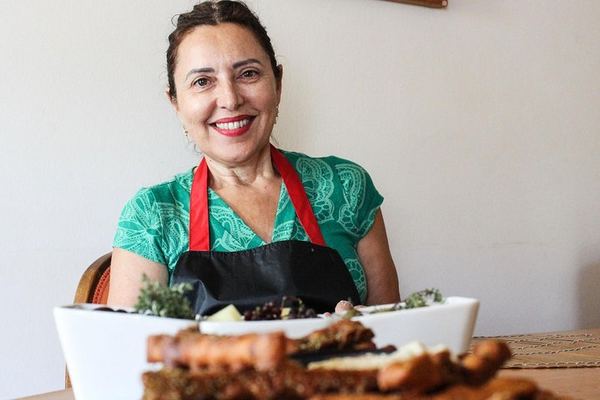
Private Cooking Class with Katerina in a Cholargos Home
Two or three traditional dishes in a residential Athens kitchen, taught by a cook who spent seven years as a private chef on the Greek islands. Your group only.
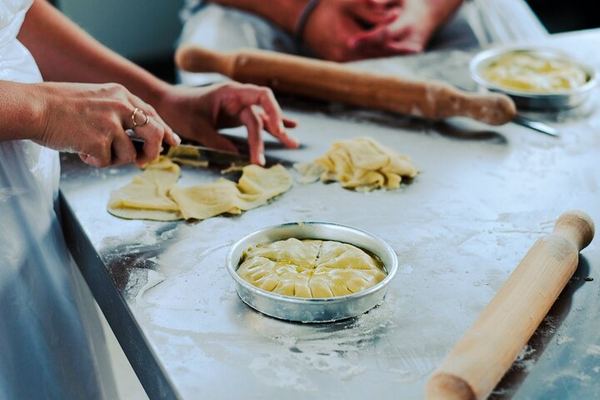
Psirri Rooftop Cooking Class in Athens: Moussaka and Phyllo Pies
Moussaka, spanakopita and milk pie made from scratch in Psirri, then eaten on a rooftop with the Parthenon lit up across the way. Dinner included, from 4pm.
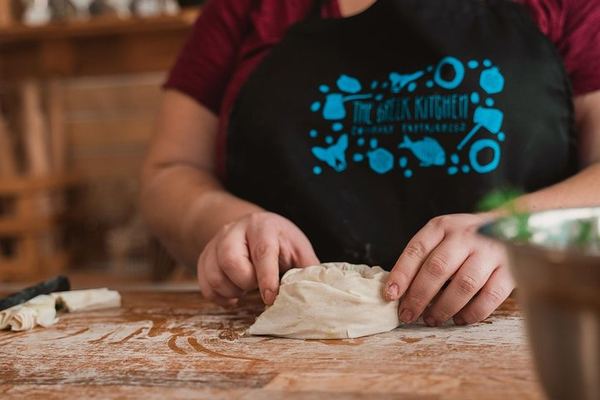
The Greek Kitchen Cooking Class in Athens with Market Walk
A four-hour class with Athenian home cooks on Athinas Street, opened by a thirty-minute walk through the central market. Ten places, recipes to take home.
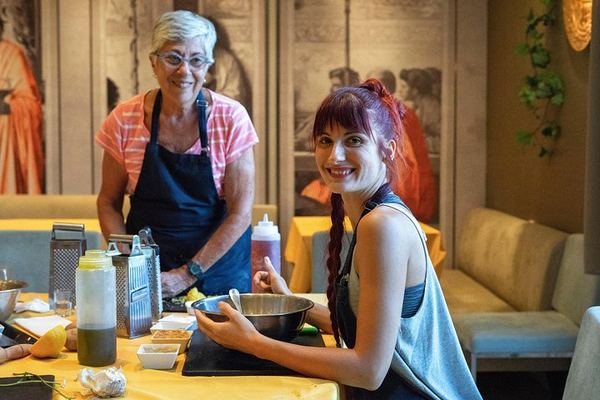
Thissio Cooking Class in Athens: Greek Family Recipes and Dinner
Four hours in a restaurant kitchen on Apostolou Pavlou below the Acropolis, cooking family recipes, then sitting down to starters, a main and dessert.
Ratings collected by Viator and Tripadvisor
What you will cook, and what it is actually teaching
The syllabus is consistent: something with aubergine, something wrapped, something in filo, and a dessert. Underneath that there are three techniques worth having.
Filo, stretched by hand. This is the real skill, and it is the reason the 163 EUR class exists as a specialist product. Commercial filo comes in a packet; hand stretched filo is pulled over a floured table until it is translucent, and the difference in a spanakopita is not subtle. It takes practice and it is genuinely satisfying, and it is the one thing on this page you will not learn adequately from a video.
The layering of a moussaka. Aubergine, meat, béchamel. The technical points are salting and drying the aubergine so the dish is not oily, and getting the béchamel thick enough to set rather than run.
One thing to know while you are making it: this version of moussaka is not ancient. The béchamel top was codified in the early twentieth century by the cook Nikolaos Tselementes, who was deliberately Europeanising Greek cooking and reducing its Ottoman spicing. It is documented in academic work on the period. It is a very good dish with a short history.
Wrapping dolmades. Tedious, easy to do badly, and the fastest way to spot someone who has done it before. Vine leaves, rice, herbs, rolled tight enough to hold and loose enough for the rice to swell.
| Type | How many | Price | What you are paying for |
|---|---|---|---|
| Standard class, indoor kitchen | 6 | 59 to 83 EUR | The teaching, four dishes, and the meal at the end |
| Rooftop or terrace with Acropolis view | 4 | 83 to 123 EUR | The same class, plus the view while you eat it |
| With a market visit first | 3 | About 90 to 110 EUR | An hour of shopping before the kitchen |
| Specialist filo class | 1 | 163 EUR | Hand stretched pastry, taught properly. A different lesson |
| Vegan or vegetarian focused | 1 | Mid range | Built around the fasting repertoire rather than adapted |

The fasting food is the best vegetarian cooking in Europe
Greek Orthodox practice involves fasting for a substantial part of the year, and fasting here means no meat, no dairy and no eggs. Over centuries that produced an entire body of dishes, nistisima, built to be satisfying without any animal product at all: gigantes beans baked in tomato, fava made from yellow split peas, briam, horta, dolmades made without meat, and everything with olive oil doing the work of butter.
The consequence for a visitor is that Greek vegan food is not an adaptation of something else. It is a tradition with its own recipes, and any class here can teach it without substitutions or apology. One listing is built around it explicitly, and every other one on this page will accommodate it if told in advance.
Why the classes cost more than the tours here
In Rome the class median is 56 EUR against 82 for a walk. In Florence it is 50 against 110. In Athens it is 96 against 79, and the classes are the expensive half. That is the reverse of the pattern everywhere else on this site.
Two things explain it. The first is the rooftops: Athens has a specific and finite asset, which is a view of a 2,500 year old temple from a terrace, and four of these classes have one. The second is that the tours here are competing hard on a very narrow band, nineteen of twenty between 55 and 123, which has pushed their prices down rather than the classes' up.
The practical reading: if you want the teaching, the 59 to 83 EUR classes are the value, and they are in ordinary kitchens with the same syllabus. If you want to eat a moussaka you made on a terrace with the Parthenon lit up in front of you, that is a legitimate thing to want and it costs about 40 euros more.
The market classes, and the honest caveat
Three of these begin with a market visit, usually the central market or a neighbourhood street market, and everywhere else on this site we would tell you those are the ones to book. In Athens there is a wrinkle: no official source publishes the central market's opening hours or its closing day, so an operator's ability to include it depends on the day and the hour you have chosen.
The street markets, the laikés agorés, are the better bet and there are around 195 of them across Athens and Piraeus, each in a different neighbourhood on a different day of the week, running from dawn until about three. A class that uses one of those is using a market that will definitely be there.
If the shopping is what you want and no class fits your dates, go to a laikí on your own. It costs nothing, everyone will talk to you, and you will learn as much about Greek cooking in an hour as in a fair few classes.
Two classes, one price, one supplier
Two listings here carry the identical price of 162.53 EUR and come from the same supplier. They are the top of the page and, as far as we can tell from the descriptions, differ in what they teach rather than in format.
It is worth flagging only because a page with fourteen items and a wide price range invites the assumption that the top two are the premium tier. They are the same operator's two specialist classes, and one of them is the filo class, which is the more interesting purchase.
Five listings here have fewer than sixty reviews. In a category where every score is between 4.9 and 5.0, that is the number that carries the information.
Questions about cooking classes in Athens
How long is a class?
About four hours including the meal, and longer if a market visit is included. Most run late morning into the afternoon or late afternoon into the evening, finishing with what you cooked, usually with wine.
Is the rooftop worth the extra?
It is roughly 40 euros over an indoor class for the same teaching. Athens has a great many rooftop bars where the same view costs the price of a drink, so the honest answer is that you are buying a setting, not a better lesson. If it is a special occasion, it is a very good setting.
What is the 163 euro class?
A specialist class in hand stretched filo pastry. It is the most expensive listing here and, unlike the rooftops, it is a genuinely different lesson: filo pulled by hand until it is translucent is a real skill, it is hard to learn from written instructions, and it changes every pie you make afterwards.
Can these classes be vegan?
Better than almost anywhere. The Orthodox fasting tradition produced a whole repertoire without meat, dairy or eggs, so a vegan Greek class is teaching real dishes rather than substituted ones. One listing is built around it; the rest will adapt with notice.
Class or food tour in Athens?
Unusually, the tour is the cheaper option here: a median of 79 EUR against 96. Take the tour if you want the city and the markets, the class if you want to cook and, in four cases, to eat on a terrace with a view of the Acropolis. Nothing appears in both categories, so there is no overlap to worry about.
Will I be able to buy the ingredients at home?
Mostly, and the important one travels well: Greek dried oregano is a different plant from the Italian sort and it is the single most useful thing to bring back. Vine leaves come in jars anywhere, filo in packets. What you will miss is good feta, which varies enormously outside Greece, and fresh horta, which has no real substitute.
Data verified on. Prices, ratings, review counts and formats read from the 14 listings on this page on 4 September 2026. The béchamel moussaka's early twentieth century codification from published academic work.